
Consultation Is Not Consent: Rights Holders Demand Power at the Asia-Pacific UN Business and Human Rights Forum
The 8th UN Responsible Business and Human Rights Forum, Asia-Pacific wrapped up last week in Bangkok. What resonated most for me was this: rights holders want to shape the decisions that affect them, and the prevailing top-down approach to stakeholder engagement falls far short of that. Across sessions on the right to development, women human rights defenders, critical mineral mining and Indigenous governance, rights holders called for participation from the earliest stages of a project and for respect for Indigenous Peoples' right to free, prior and informed consent (FPIC). Yet they described engagement designed around corporate compliance, not co-design, and how this leaves companies failing to prevent human rights harms.
Commitments on paper, not in practice.
"Companies have good guidelines. But when we ask about progress, there is silence. There is a question of implementation." – Frederic Wilson, Asia Indigenous Peoples Pact
The gap between policy and practice ran through the Forum. At From Protection to Power, Dr. Pichamon Yeophantong, a member of the UN Working Group on Business and Human Rights, previewed the Working Group's evaluation of National Action Plans (NAPs) in the region. The evaluation asks whether NAPs are producing real impacts for rights holders. The overarching finding is that commitments are relatively strong, but implementation is uneven and under-resourced. None of the plans has a publicly documented implementation budget. For Indigenous Peoples, consultation processes remain inadequate and inaccessible, even as businesses and governments become more creative, and more insidious, in how they violate rights.
At a business and civil society dialogue, Frederic Wilson noted that we have been talking about FPIC for 30 years. Yet engagement still comes late, after a project has started. This kind of tick-the-box consultation is counterproductive, he said. It breeds distrust and eliminates the right to consent altogether. He called for a shift to co-ownership and co-design.
Consultation is not participation.
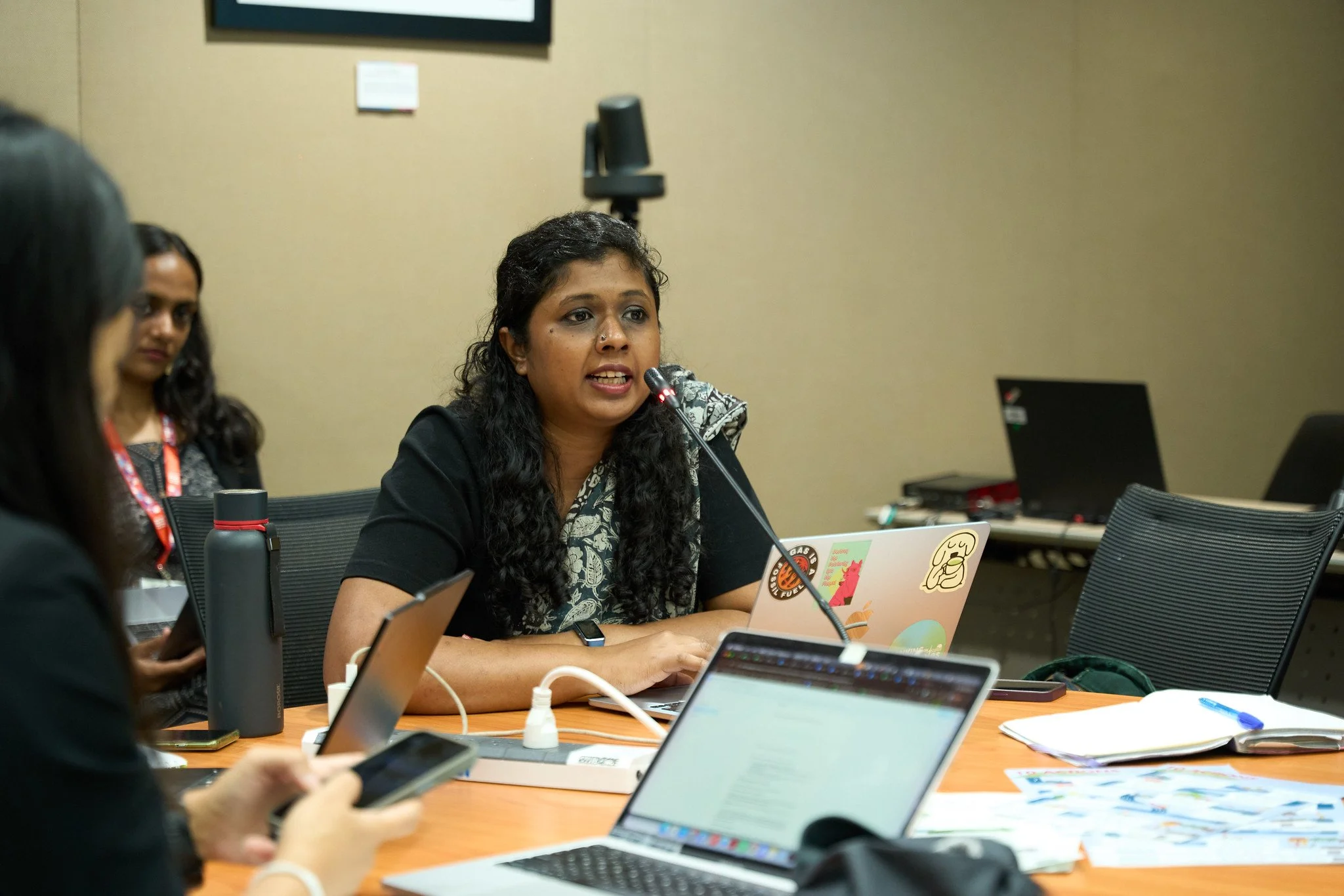
"Consultation does not equal consent. The shift is long overdue to free, meaningful and active participation." – Vaishnavi Varadarajan, International Accountability Project
Photo credit: UNBHR 2026; License: CC BY-NC-SA 4.0
In a session his latest report, Professor Surya Deva, the UN Special Rapporteur on the right to development, described how consultations are part of the development ecosystem, but they are not working. He called on states and companies to move away from "consultation" toward "active, free and meaningful participation" in development decisions.
Rights holders on the same panel described what vertical looks like in practice. Kalpona Akter of the Bangladesh Center for Workers Solidarity said "social dialogue" has become a buzzword that companies use to discharge their responsibilities. She pointed to companies with engagement policies that hold only one or two meetings with workers. Workers, she said, want to be there "from the very beginning." Krishna Dangol of Indigenous Peoples Rights International described company meetings where the information is highly technical and shared only in the national language. Indigenous Peoples are often informed after decisions have been made, with little time and almost no influence over the outcome. He called for accountability, and access to remedy, when participation rights are violated.
The same message came from communities facing the rush for transition minerals. At a session on enforcing FPIC in critical mineral mining, Surti Handayani, with the Association Of Indigenous Peoples Defender Of The Archipelago (PPMAN), described how nickel mining expansion is threatening the O’Hongana Manyawa Indigenous Peoples on Halmahera Island, Indonesia and called for placing affected communities at the center of just transition planning. Norlita Colil, an Indigenous activist resisting nickel mining in Palawan, Philippines, said FPIC must be designed around the rights of Indigenous Peoples, not a company's need to secure a permit. A top-down process, she said, is mere compliance. A representative of the UN Working Group, drawing on its new FPIC guidance, underscored the point: FPIC is a right, not a one-off event.
Participation requires safety.
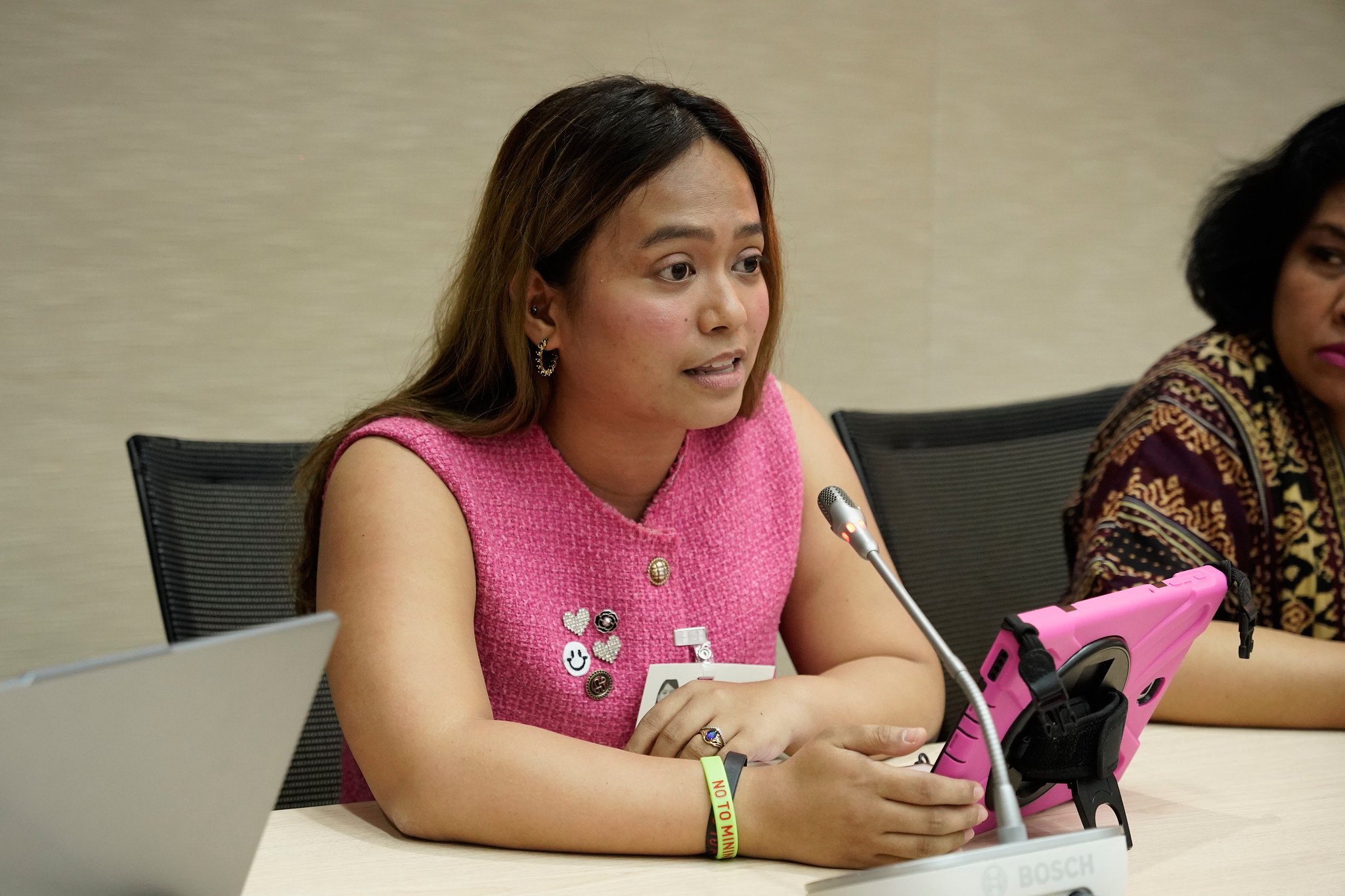
"Enough calling our exhaustion resilience. We do not want applause, we want accountability." – Elice Baliong, Lawyer from a mining-affected community in Nueva Vizcaya, Philippines
Photo credit: UNBHR 2026; License: CC BY-NC-SA 4.0
Meaningful dialogue is not possible when rights holders face intimidation and repression. At Resilience Across Borders: How Women Reclaim Their Space, a lawyer from a mining-affected community in Nueva Vizcaya explained that mining projects arrived without the genuine consultation her country's constitution requires. When the community objected, it was met with police presence, displacement and disappearances. The Asia-Pacific Network of Environmental Defenders' report, Rise and Resist, and the Southeast Asia Freedom of Expression Network's research on technology-facilitated violence document the gender-based violence, criminalization and online attacks that women defenders face.
Even consultants advising companies acknowledged the problem. At a session on heightened human rights due diligence, Feybe Lumuru of Daemeter described a government-led relocation in Indonesia that not all residents agreed to. Senior military staff attended community meetings, as Indonesian regulation requires. "In human rights due diligence, silence can be very misleading," she said. "Silence can mean disagreement." To hear what people would not say in those meetings, her team lived in the village for weeks at a time, held confidential interviews and ran focus groups with vulnerable groups.
Communities are already leading. They need to be recognized and resourced.
Wanun Permpibul of Climate Watch Thailand asked: who bears the cost of participation? Consultants, project staff and government officials are paid. Communities participate on their own time and at their own expense. They travel for hours, arrange childcare and elder care, and lose a day's work, and they have contributed years of knowledge for free. Exercising a right, she argued, should not create an unequal burden.
The fundamental question, Permpibul added, is where power sits: who defines the problem, who sets the agenda, whose knowledge counts and who ultimately decides. Real participation would mean communities could: define the development they want; choose their own local experts; direct funds to community-controlled institutions; and originate proposals themselves rather than respond to ones brought from outside. Vaishnavi Varadarajan of International Accountability Project (IAP) also emphasized communities’ own development plans should count as legitimate, and that more support is needed for community-led solutions.
Communities are already building these alternatives. At From Protection to Power, a speaker from Malaysia described community protocols: living sets of rules that communities develop, monitor and enforce themselves, setting the terms on which outsiders must engage.
Supporting that kind of leadership was the focus of the table Just Ground co-hosted with IAP and EarthRights International at the Forum's BHR Asia Exchange Cafe on Learning and Practice. Vaishnavi Varadarajan demonstrated IAP's Early Warning System, which tracks projects funded by development banks, and shares information on them, ideally before funding is decided, so communities can prepare and engage early. Yen Snaing explained EarthRights' Local Engagement, Action, and Dialogue (LEAD) program, which supports community-led research. Community members choose their own questions, gather their own evidence and own what they find. Just Ground has supported this process through collaboration on a LEAD cohort and a series in-person workshops.
As I have written before, whether due diligence becomes a tick-the-box exercise or a driver of real change will turn on the quality of stakeholder engagement. Rights holders in Bangkok were clear that quality requires rights holder agency in the process, including:
Participation in decisions and co-design
Respect for FPIC
Safety from reprisals
Recognition of their expertise
Compensation for their time
Accountability and remedy when companies fail to deliver any of it
This is at the heart of Just Ground's work supporting community-led responses to business and human rights challenges. Until companies, governments and investors treat participation as a shift in power rather than a procedural step, rights holders will keep telling us, forum after forum, that consultation is not consent.